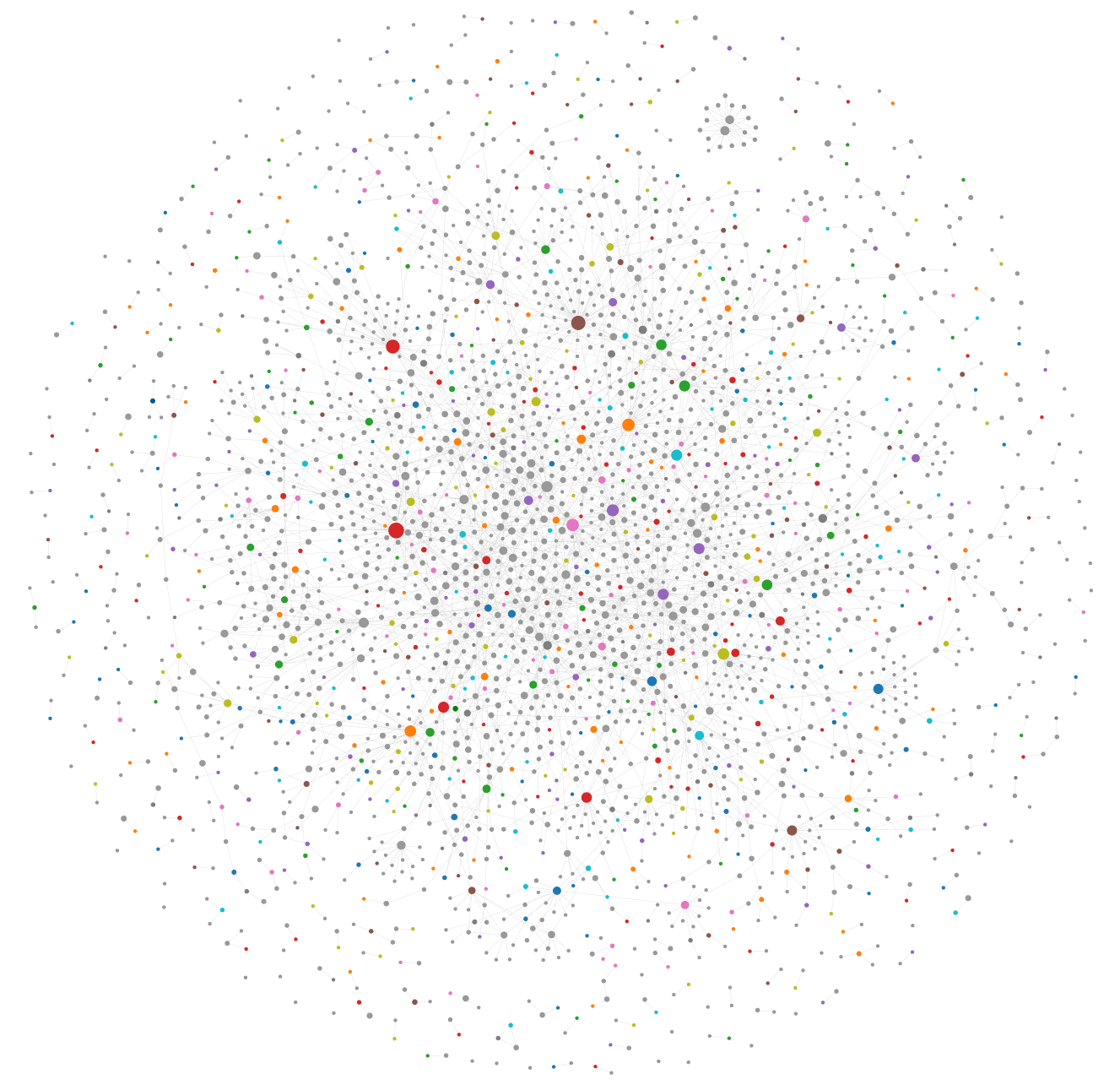
High level view of one of my personal knowledge graph (approx. 3k nodes)
During August and Septmber 2025 I’ll extend this section further, so stay tuned.
The story behind #
I am collecting valuable (and sometimes not so valuable) sources that helped me to master my challenges since more than three decades. Initially, my information was scattered and included cut-out articles, a “Zettelkasten”, hand-drawn mind maps, etc.. With the advent of digital technology, my knowledge migrated to text files, blogs, electronic cue cards, browser bookmarks, Twitter threads (for a while), etc.. Additionally, I’ve always maintained a collection of books. Some of them aged well, other not so much but I have hard time to throw them away.
Collecting knowledge has been fun, fulfilling, and sometimes even entertaining, but accessing my “2nd brain” posed all too often challenges:
Accessibility and Availability #
I spent far too much time finding that great article I ?bookmarked?, ?added to my Zettelkasten?, ?saved to my private blog? Sources were hard to find. Pages I bookmarked went offline or disappeared behind a paywall. Some sources where only accessible from the devices I stored them on.
Structure and Connectivity #
Charly Munger once said: “What is elementary, worldly wisdom? Well, the first rule is that you can’t really know anything if you just remember isolated facts and try and bang ’em back. If the facts don’t hang together on a latticework of theory, you don’t have them in a usable form.” With my knowledge distributed across several locations and technologies it was nearly impossible to put it into a “latticework” so that I was able to connecting the dots, a key ingredients to transfer information to knowledge.
Granularity #
When I came across challenges in the workplace, I often needed just the key facts of a certain topic, framework or technology, but I needed it quickly. I would not have the time to re-read a longer article or search in a book. My PKB now gives me the possibility to create derivatives that fit a particular need, e.g. creating my very own framework to tackle a given problem.
Upon discovering a new generation of tools in 2022, I realized there was a better way to tackle these challenges. I made the decision to reorganize my entire collection by migrating everything into a tool called logseq. What made this particularly appealing is that it’s open-source and stores all my content locally in a plain Markdown format. This approach completely eliminates vendor lock-in, which means that even in a worst-case scenario, my data remains mine, and I have the freedom to use it with any other compatible tool.